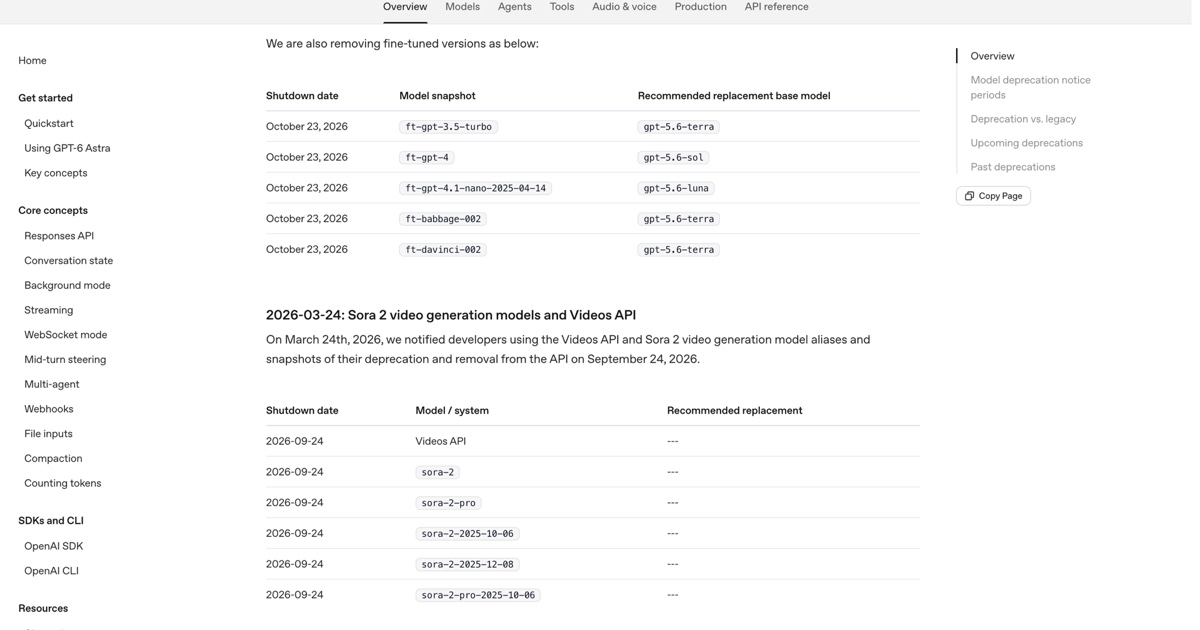
As of September 22, 2026, published AI video API prices span roughly $0.03 to $0.60 per output second, but the lowest rate often requires a large prepaid package or a lower resolution. Runway Gen-4 Turbo is $0.05 per second, Google Veo 3.1 Lite starts at $0.05 per second, Alibaba Wan 3.0 lists $0.10 per second at 720p before a stated 30% promotion, and MiniMax's cheapest calculated package rate comes with a $1,000 minimum.
Those numbers are starting points, not quality rankings. Input video, reference media, audio, resolution, minimum charges, failed jobs, retries, tax, storage, upscaling, and unused prepaid capacity can all change the real bill. This comparison keeps each provider's own billing unit visible instead of pretending that every API sells the same output.
Last verified: September 22, 2026. Prices are in USD and exclude tax.
TL;DR
- For a small prototype, use a true pay-as-you-go API with no large upfront package. Runway, Google, and Alibaba publish usable per-second rates.
- At 720p, the lowest public starting figures in this comparison are $0.05 per second for Runway Gen-4 Turbo and Google Veo 3.1 Lite. Wan 3.0 lists $0.10 per second, with a stated 30% limited-time discount.
- MiniMax can calculate to about $0.029 to $0.089 per second on its $1,000 Hailuo package, depending on model, duration, and resolution. The package expires after one month, so unused capacity raises the effective cost.
- Sora is not a sensible new purchase: OpenAI's Videos API and Sora 2 models are scheduled to shut down on September 24, 2026.
Quick Answer
Compare a fixed output specification, then add the costs the headline rate leaves out. For a 5-second clip, multiply the published rate by five. If a provider bills input and output video, add both durations. For prepaid points, divide the package price by total points, multiply by the points for your exact clip, and account for any points that expire unused. The lowest price per generated second is rarely the lowest price per accepted shot.
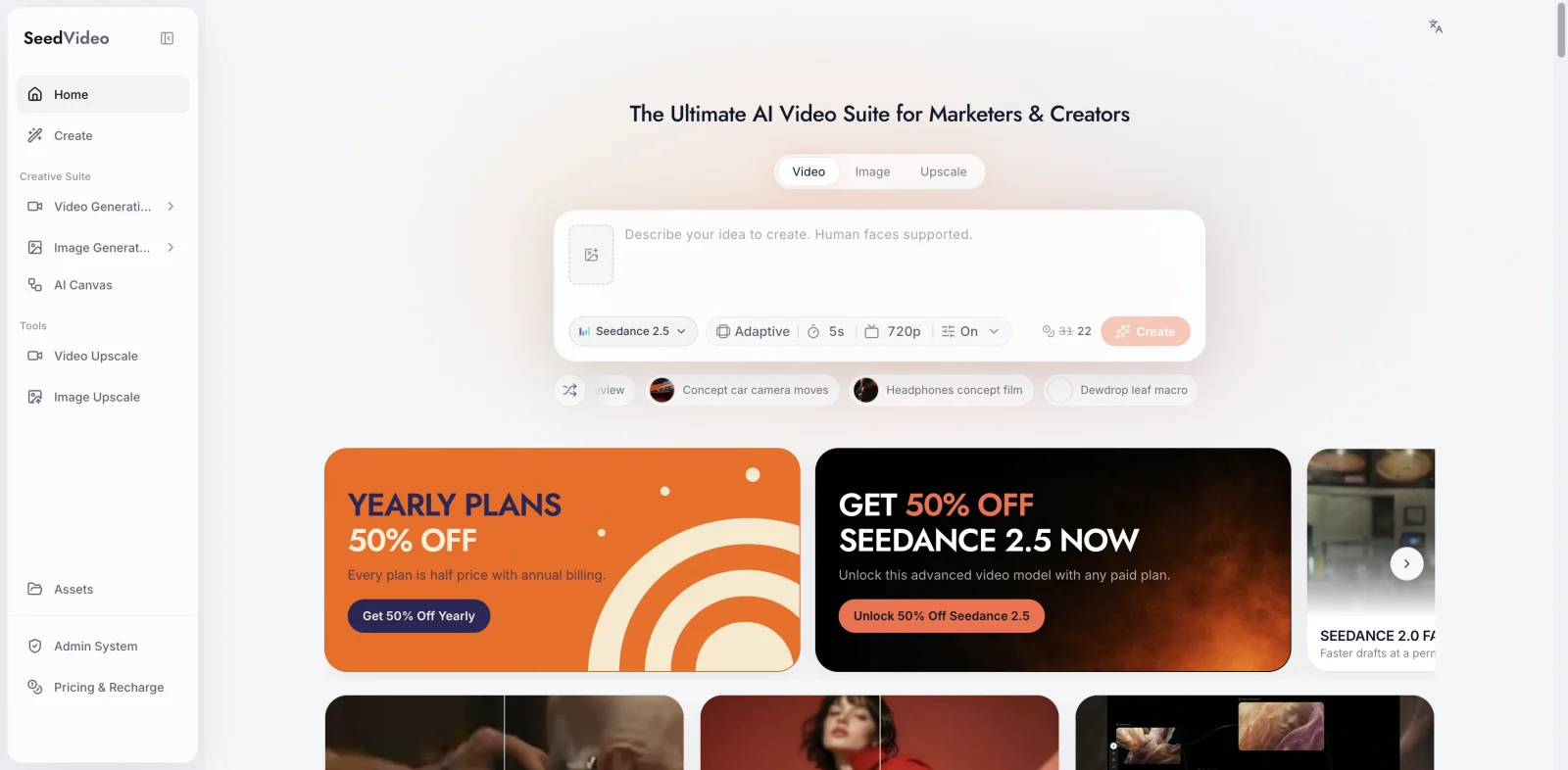
If you need a multi-model creative workspace rather than direct infrastructure billing, review the current SeedVideo AI pricing plans. The plan page uses credits and plan discounts, so do not substitute its consumer cost-per-video figures for upstream API rates.
AI video API pricing comparison
| Provider and model | Published price per output second | Minimum purchase | Resolution tier used | Commercial-use wording | Best for | Not for |
|---|---|---|---|---|---|---|
| Runway Dev, Gen-4 Turbo | $0.05 | No public minimum; credits cost $0.01 each | Provider model output | Runway terms govern; pricing page gives no separate blanket license | Small prototypes and image-to-video API work | Teams that need a stated 1080p tier in the price table |
| Runway Dev, Gen-4.5 | $0.12 | No public minimum | Provider model output; ProRes and HDR cost extra | Runway terms govern | Higher-end Runway generation and editorial formats | Lowest-cost bulk drafts |
| Google Veo 3.1 Lite | $0.05 at 720p; $0.08 at 1080p | No free tier; paid billing account | 720p or 1080p | Gemini API terms govern; paid-tier content is not used to improve Google's products | Low-cost Veo access with audio | 4K, which Lite does not support |
| Google Veo 3.1 Fast | $0.10 at 720p; $0.12 at 1080p; $0.30 at 4K | No free tier; paid billing account | 720p, 1080p, or 4K | Gemini API terms govern | Veo speed with a published 4K tier | The cheapest Veo option |
| Google Veo 3.1 Standard | $0.40 at 720p or 1080p; $0.60 at 4K | No free tier; paid billing account | 720p, 1080p, or 4K | Gemini API terms govern | Projects choosing Veo Standard for its model behavior | Price-sensitive iteration |
| Alibaba Wan 3.0 | $0.10 list at 720p; $0.20 list at 1080p; page states 30% off | Pay as you go; 30-second free quota in eligible regions | 720p or 1080p | Alibaba Cloud service terms govern | Regional deployment and transparent resolution pricing | Budgets that cannot tolerate promotional price changes |
| Alibaba Wan 3.0 Prime | $0.14 at 720p; $0.28 at 1080p | Pay as you go; 30-second free quota in eligible regions | 720p or 1080p | Alibaba Cloud service terms govern | Wan's Prime model with clear metering | The lowest Wan API rate |
| MiniMax Hailuo package | About $0.029 to $0.089 when the $1,000 package is fully used | $1,000 for 3,760 points, valid one month | 768p or 1080p, depending on model | Package page does not state a standalone commercial license; MiniMax terms govern | High, predictable Hailuo volume | Prototypes and uncertain monthly demand |
| OpenAI Sora 2 API | Retiring; do not budget as a new long-term service | Not applicable | Existing Sora 2 tiers | OpenAI terms apply until shutdown | Finishing an already-approved migration window | Any new production integration |
The table uses stable list prices where a promotion is explicitly temporary. Alibaba's page labels Wan 3.0 with a limited-time 30% discount, which implies about $0.07 per second at 720p and $0.14 at 1080p while the offer applies. Recheck the invoice or console before relying on a promotional rate.
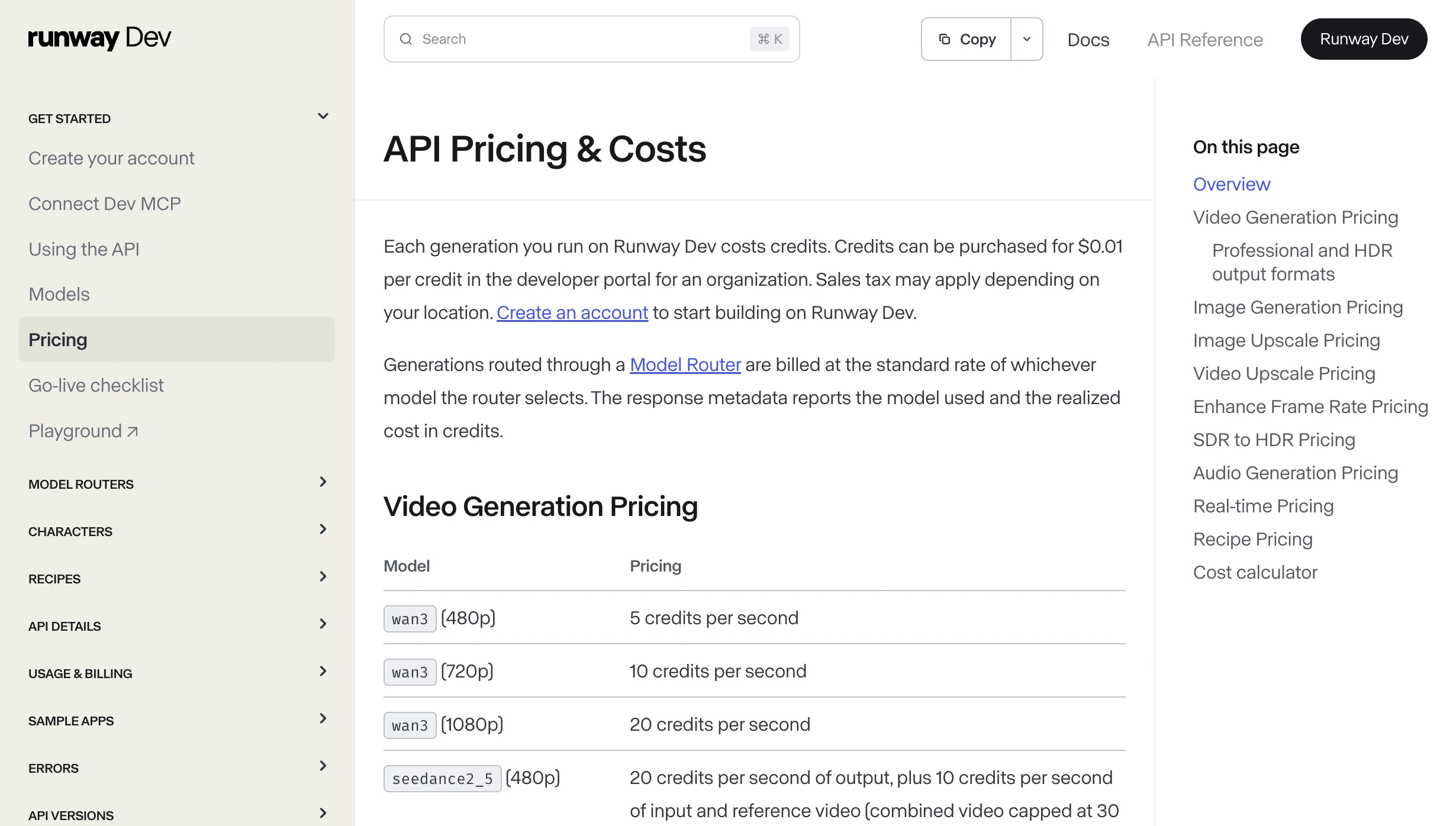
Runway Dev official API pricing page, captured September 22, 2026. One credit costs $0.01, and video models are billed in credits per second.
What each provider actually charges
Runway Dev
Runway sells developer credits at $0.01 each. Gen-4 Turbo uses 5 credits per second, so its direct generation rate is $0.05 per second. Gen-4.5 uses 12 credits per second, or $0.12. The same catalog also exposes other models at their own rates, including Seedance 2.5 at $0.20 per second for 480p, $0.30 for 720p, and $0.68 for 1080p output. Seedance 2.5 also bills input and reference-video duration and has an 80-credit minimum per generation.
Professional output is another line item. ProRes or PNG sequences add 5 credits per second. Ten-bit and HDR profiles add 20 credits per second, rising to 40 credits when the output exceeds roughly 4K. A workflow that needs editorial masters should budget the format surcharge from the start.
Official source: Runway Dev API pricing.
Google Veo 3.1
Google's price table is unusually direct. Veo 3.1 Lite with audio costs $0.05 per second at 720p and $0.08 at 1080p. Fast costs $0.10, $0.12, or $0.30 at 720p, 1080p, or 4K. Standard costs $0.40 at 720p or 1080p and $0.60 at 4K. There is no free tier for these Veo entries.
Google also states that a failed generation caused by an audio-processing issue is not charged. That rule helps with provider-side failure risk, but ordinary creative retries still cost money.
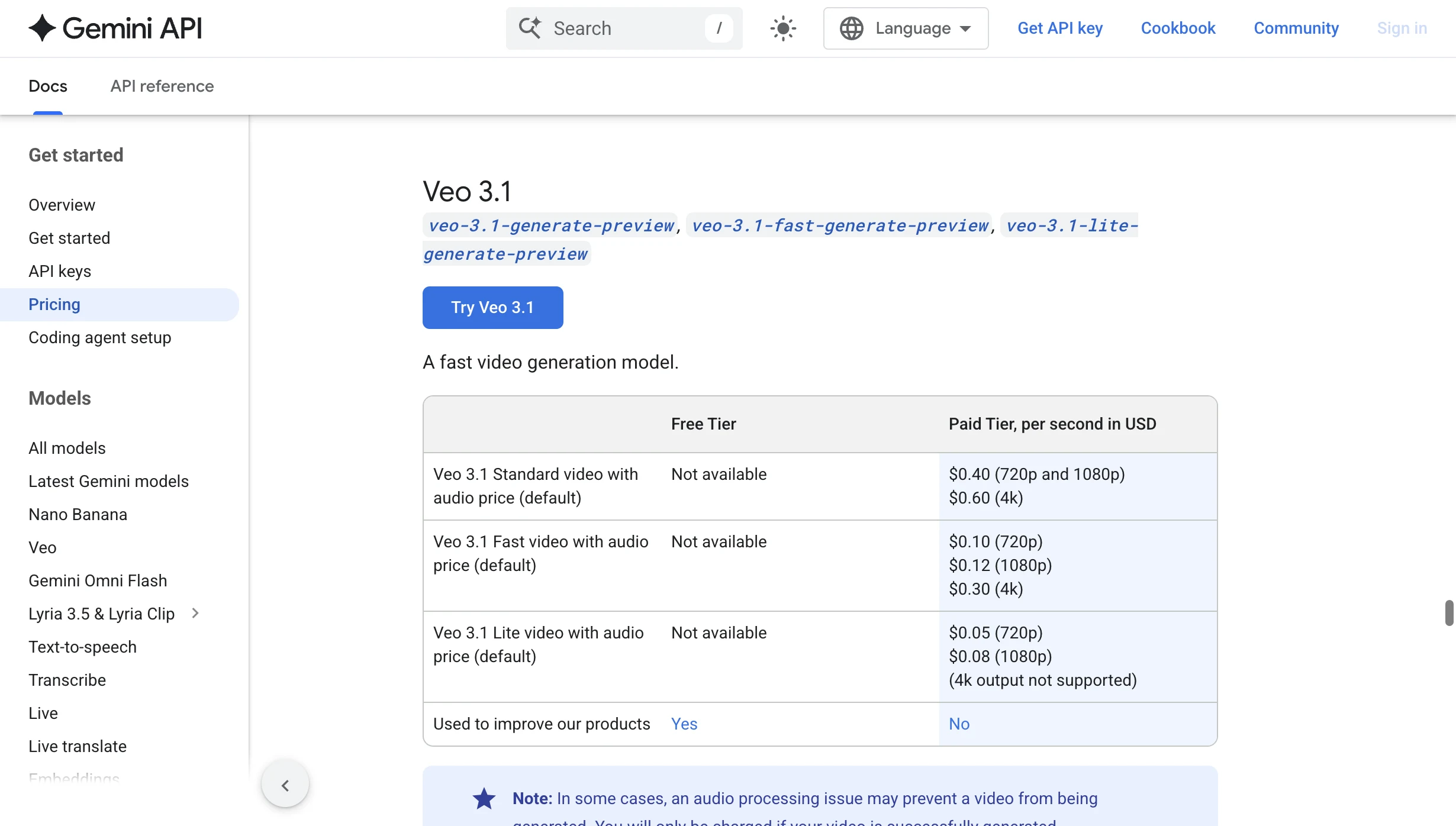
Google's official Gemini API price table for Veo 3.1, captured September 22, 2026, with Lite, Fast, and Standard rates by resolution.
Official source: Gemini API pricing for Veo 3.1.
Alibaba Cloud Wan
Alibaba bills Wan by video duration. Wan 3.0 charges for both input and output video seconds, while text-to-video has no input-video duration. The international list price is $0.10 per second at 720p and $0.20 at 1080p. Wan 3.0 Prime is $0.14 and $0.28. The page says failed requests are not billed and gives eligible users a 30-second quota, limited by region.
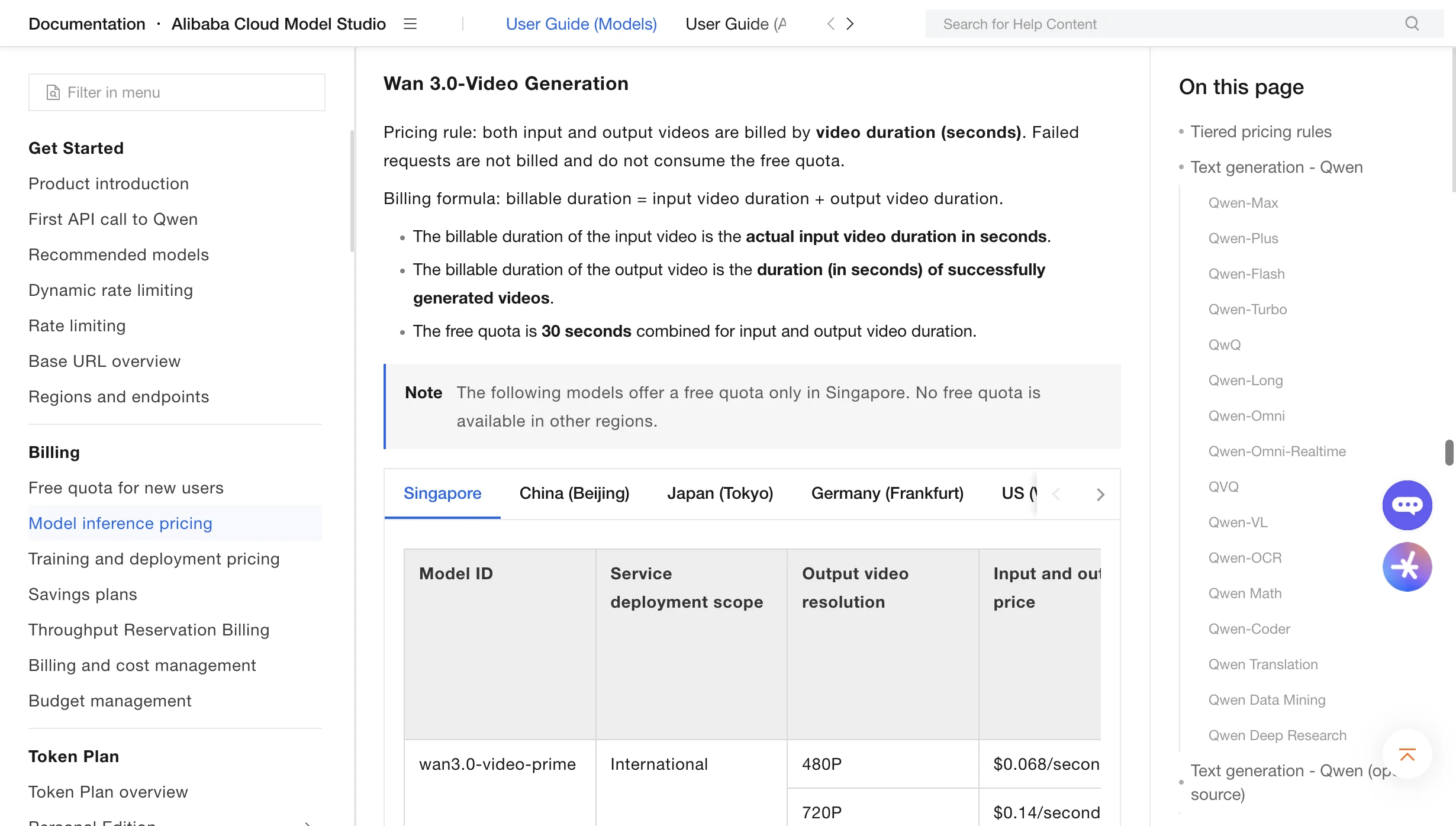
Alibaba Cloud Model Studio's official Wan 3.0 pricing section, captured September 22, 2026, showing duration billing and resolution tiers.
Official source: Alibaba Cloud Model Studio pricing.
MiniMax Hailuo packages
MiniMax's public video packages are prepaid rather than simple pay-as-you-go. The entry package costs $1,000, includes 3,760 video points, and expires after one month. A 10-second, 768p Hailuo 2.3 Fast generation uses 1.1 points. If the package is fully consumed on that job type, the arithmetic is about $0.293 per clip or $0.029 per second.
The low calculated rate comes with two catches. The buyer must commit $1,000, and unused points disappear at expiry. The package currently supports Hailuo models but not MiniMax H3; H3 uses pay-as-you-go pricing or a custom agreement.
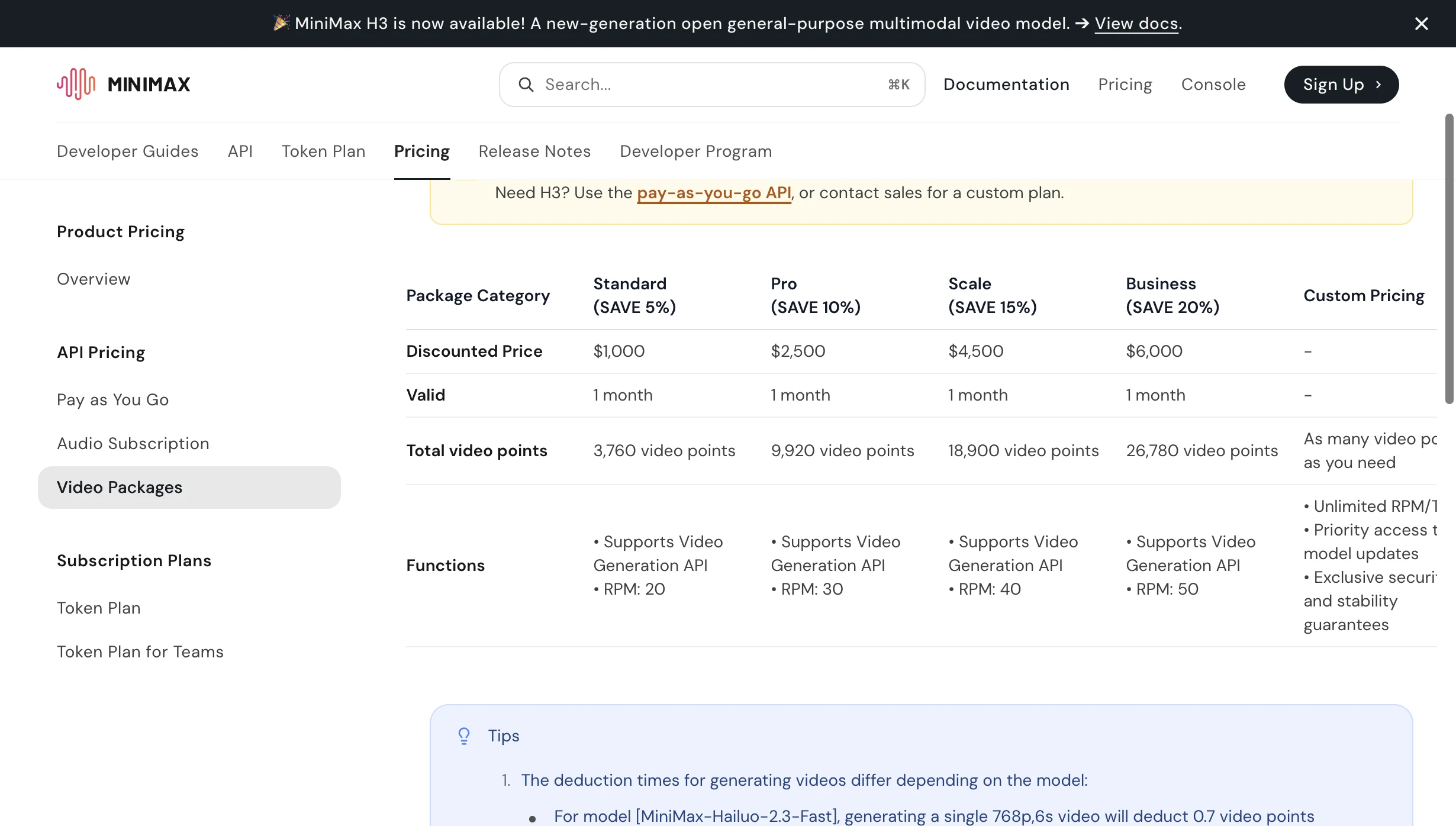
MiniMax's official video package page, captured September 22, 2026, showing prepaid package capacity and model-specific point deductions.
Official source: MiniMax video package pricing.
Three billing traps
Credits hide the dollar rate
A credit has no shared value across providers. Runway makes the conversion easy because one developer credit equals $0.01. Another platform may sell subscription credits, bonus credits, or expiring points with a different dollar value. Convert everything to dollars before comparing.
Per-second may include more than output
Alibaba Wan 3.0 can bill input-video plus output-video duration. Runway's Seedance 2.5 rate also adds input and reference-video seconds. A five-second edit with a ten-second source is not always billed as a five-second job.
Prepaid savings assume full usage
MiniMax's package rate only reaches its calculated floor when the points are used before expiry. Spending $1,000 to generate 10,000 seconds during the month makes the effective cash cost $0.10 per used second, even if the fully utilized package could calculate below $0.03.
Budget scenarios
| Scenario | Practical choice | Budget logic |
|---|---|---|
| Prototype: 100 five-second clips | Runway Gen-4 Turbo or Veo 3.1 Lite | About $25 in generation charges before retries, with no $1,000 package commitment |
| Small launch: 10,000 output seconds | Compare Veo Lite, Runway Turbo, and Wan 3.0 promotional billing | Headline generation cost is roughly $500, $500, or $700 during Wan's stated discount, before extras |
| High-volume Hailuo production | MiniMax package, only with predictable monthly usage | The entry package can be efficient when its 3,760 points are fully consumed before the one-month expiry |
| Premium or 4K delivery | Choose the required model first, then price the exact tier | Veo Standard 4K is $0.60 per second; format, resolution, and accepted-shot rate dominate the budget |
For a broader consumer-plan comparison, use the AI video generator price comparison by cost per clip. If you are replacing OpenAI's endpoint this week, the Sora API shutdown migration guide covers the deadline and migration choices.
A practical cost formula
Use this worksheet before choosing a provider:
- Fix the model, resolution, duration, input type, audio requirement, and output format.
- Calculate one attempt, including input or reference-video seconds and any minimum charge.
- Multiply by your observed attempts per accepted shot.
- Add upscaling, storage, egress, moderation, and post-processing.
- For prepaid packages, divide the package price by the number of seconds you will actually use before expiry, not the theoretical maximum.
That produces a production cost. A single clean API rate only produces a generation estimate.
FAQ
What is the cheapest AI video API per second in 2026?
Among the direct pay-as-you-go entries compared here, Runway Gen-4 Turbo and Google Veo 3.1 Lite both start at $0.05 per output second. MiniMax can calculate lower on a fully used $1,000 Hailuo package, but it is not the cheaper cash commitment for a small project.
How much does a five-second AI video API call cost?
At the published base rate, five seconds costs about $0.25 with Runway Gen-4 Turbo or Veo 3.1 Lite at 720p, $0.50 with Wan 3.0 at its 720p list price, and $2.00 with Veo 3.1 Standard at 720p or 1080p. Input video, audio, formats, and retries may add cost.
Do failed AI video generations cost money?
Policies differ. Google says certain Veo audio-processing failures are charged only when a video succeeds. Alibaba says failed Wan requests are not billed. Runway and MiniMax publish their own task and package rules. Creative retries that return valid but unusable videos generally still consume paid usage.
Is there a free AI video API tier?
Google's current Veo 3.1 price table says the free tier is unavailable. Alibaba lists a 30-second quota for eligible Wan 3.0 users in supported regions. MiniMax's package is prepaid. Runway developer credits are purchased, so confirm any account-specific trial offer in the developer portal rather than assuming it is universal.
Can I use API-generated videos commercially?
Pricing pages do not replace license terms. Check the provider's current service terms, your account type, and rights to every input asset. Google also states that paid-tier Gemini API content is not used to improve its products, which is a data-use statement rather than a universal commercial license.
Should I still integrate the Sora API?
No for a new long-term build. OpenAI says the Videos API, sora-2, and sora-2-pro are scheduled to shut down on September 24, 2026, with no recommended replacement listed on the deprecations page.
Choose by workload, then by rate
Start with one exact clip specification and a realistic retry rate. For occasional API work, avoid a large expiring commitment. For predictable high volume, calculate how much of a package you will actually consume. If your team also needs multiple models, a creative interface, concurrency, and one account balance, compare the current SeedVideo AI plans separately from the upstream API bill.