OpenAI shuts down the Sora API on September 24, 2026. Six entries go at once: the Videos API, sora-2, sora-2-pro and three dated snapshots. The detail worth noticing is what sits in the recommended replacement column for all six rows: three dashes. Every other deprecation on that page names a successor model. Sora has none, because OpenAI is not replacing it. Migration means changing vendors.
Last verified: 2026-09-19, against OpenAI's own deprecations page and help center.
TL;DR
- Shutdown date: September 24, 2026. Announced March 24, 2026, exactly the six-month minimum OpenAI promises for generally available models.
- The Sora web and app experiences already went dark on April 26, 2026. The API is the second and final stage.
- No successor. The recommended replacement column is empty for all six deprecated entries, so every migration path leads to a different vendor.
- Cheapest like-for-like swap: Google's Veo 3.1 Fast is $0.10 per second at 720p with audio, the same rate
sora-2charges at 720p today. - Biggest saving: if you run
sora-2-proat 1080p for $0.70 per second, Veo 3.1 Standard covers 1080p at $0.40 per second. - Export first. Content in Sora is deleted permanently after discontinuation and after any final export window closes.
Quick Answer
If you call the Videos API in production, you have until September 24, 2026. After that the endpoint and models are no longer accessible. OpenAI has not published a successor, so you are choosing between vendors rather than upgrading a model string. The realistic options are Google's Veo 3.1 through the Gemini API or Vertex AI, Runway's pay-as-you-go API, and Seeddance's video API. Veo is the closest drop-in on price and audio. Runway is the easiest single invoice across several model families. Seeddance is the option to weigh when you need long reference-driven generation rather than raw resolution.
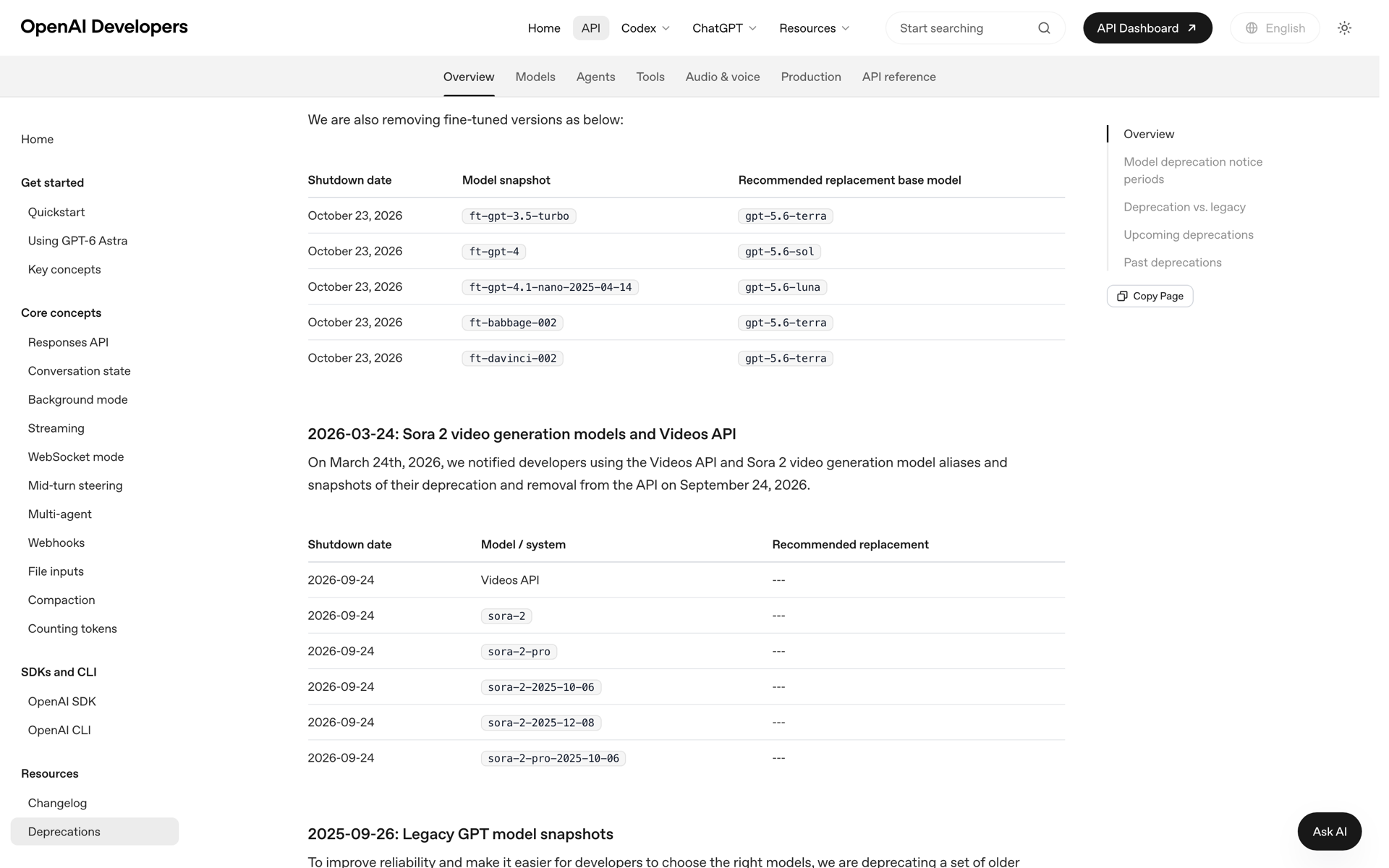
OpenAI API deprecations page, captured 2026-09-19. All six Sora rows list "---" under Recommended replacement.
The timeline, from OpenAI only
| Date | What happened | Source |
|---|---|---|
| March 24, 2026 | OpenAI notified developers using the Videos API and Sora 2 aliases and snapshots of their deprecation | Deprecations page |
| April 26, 2026 | Sora web and app experiences discontinued | Help center |
| September 24, 2026 | Sora API discontinued; Videos API and all Sora 2 models removed | Both |
OpenAI's stated policy is at least six months of notice before retiring a generally available model. March 24 to September 24 is exactly six months. Sora was not cut short, and it was not extended.
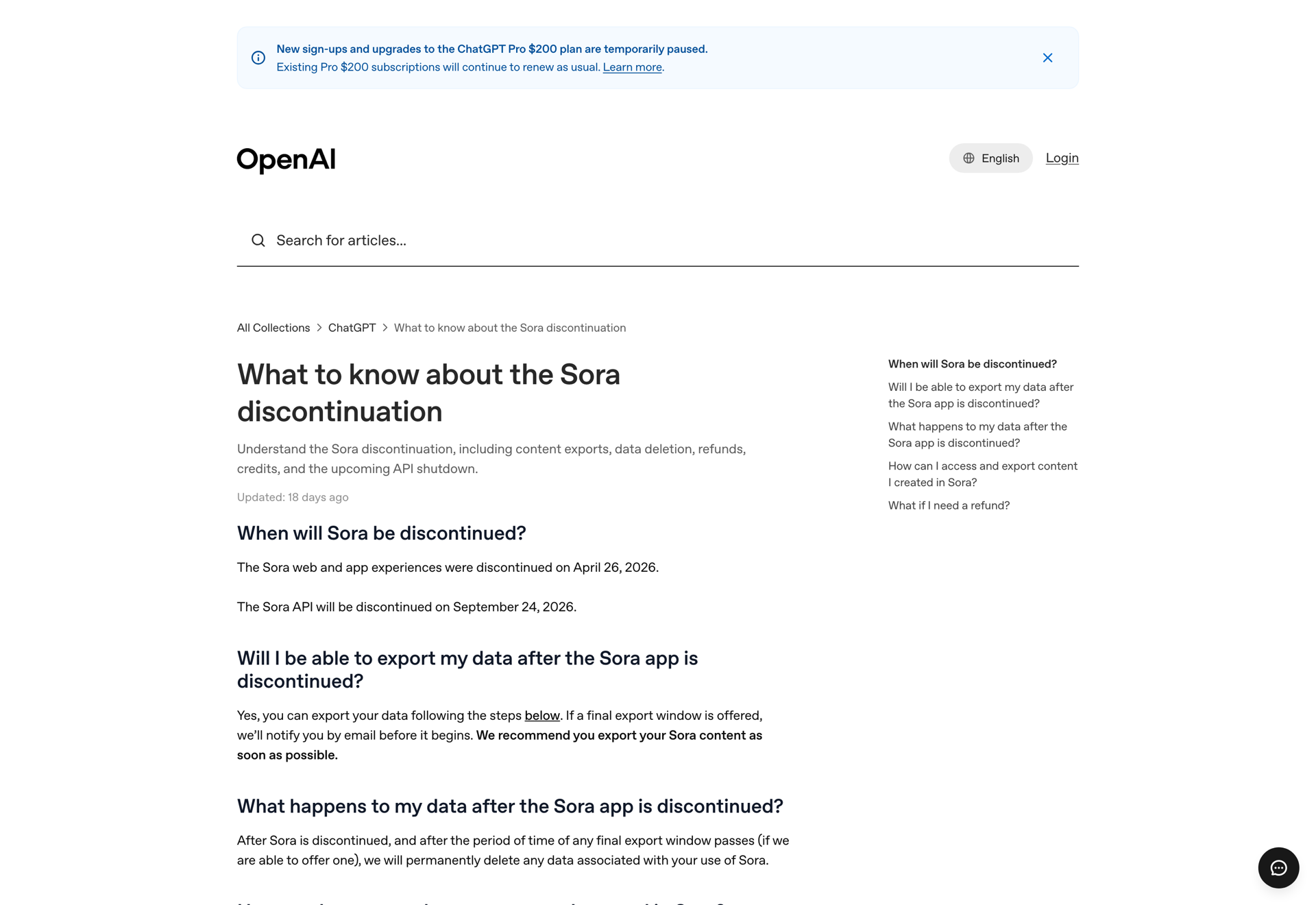
OpenAI help center, captured 2026-09-19, confirming both discontinuation dates and the export process.
Exactly what is being removed
Six entries, all with a shutdown date of 2026-09-24:
- Videos API
sora-2sora-2-prosora-2-2025-10-06sora-2-2025-12-08sora-2-pro-2025-10-06
OpenAI describes the effect in general terms rather than naming a status code: at the time of shutdown, the model or endpoint will no longer be accessible. Several secondary write-ups have circulated a specific HTTP code for what Sora requests will return after the date. That figure is not on OpenAI's page, so treat it as unconfirmed and write your error handling defensively rather than against one expected response.
Who this actually affects
API integrators. Anything calling the Videos API in production stops working on September 24. This is the group with a hard deadline and no workaround.
Teams with Sora in a workflow. Automations, internal tools and agent chains that shell out to Sora need a new provider wired in, plus new response parsing, because no alternative uses OpenAI's request shape.
Content teams with assets in Sora. Your deadline is softer but the loss is permanent. Export at sora.chatgpt.com/sunset using the Export button, and you will get an email when the archive is ready. After discontinuation, and after any final export window passes, OpenAI permanently deletes data associated with your use of Sora. Purchased ChatGPT or Sora credits can still be used for Codex if you want them to go somewhere.
Migration options compared
| Option | API availability | Price per second of video (USD) | Max resolution | Audio | OpenAI-compatible |
|---|---|---|---|---|---|
sora-2 (being removed) |
Until 2026-09-24 | $0.10 at 720p; $0.05 batch | 720p | Yes | Native |
sora-2-pro (being removed) |
Until 2026-09-24 | $0.30 at 720p, $0.50 at 1024p, $0.70 at 1080p | 1080p | Yes | Native |
| Google Veo 3.1 Standard | Gemini API and Vertex AI | $0.40 at 720p and 1080p; $0.60 at 4k | 4k | Included by default | No |
| Google Veo 3.1 Fast | Gemini API and Vertex AI | $0.10 at 720p; $0.12 at 1080p; $0.30 at 4k | 4k | Included by default | No |
| Google Veo 3.1 Lite | Gemini API and Vertex AI | $0.05 at 720p; $0.08 at 1080p | 1080p | Included by default | No |
| Runway API | Pay as you go | Video from $0.05 | Varies by model | Audio billed separately from $0.0025 | No |
| Seeddance API | Public REST API | Credit-based, not per second | 1080p on the Seedance 2.0 family, 720p on Seedance 2.5 | Per-model generate_audio support |
No |
Two honest notes on that table. Nothing on this list is OpenAI-compatible, so no migration is a base-URL swap; all of them are a rewrite of the request and polling code. And Veo has no free tier at all, on any of the three variants, so there is no zero-cost way to evaluate it.
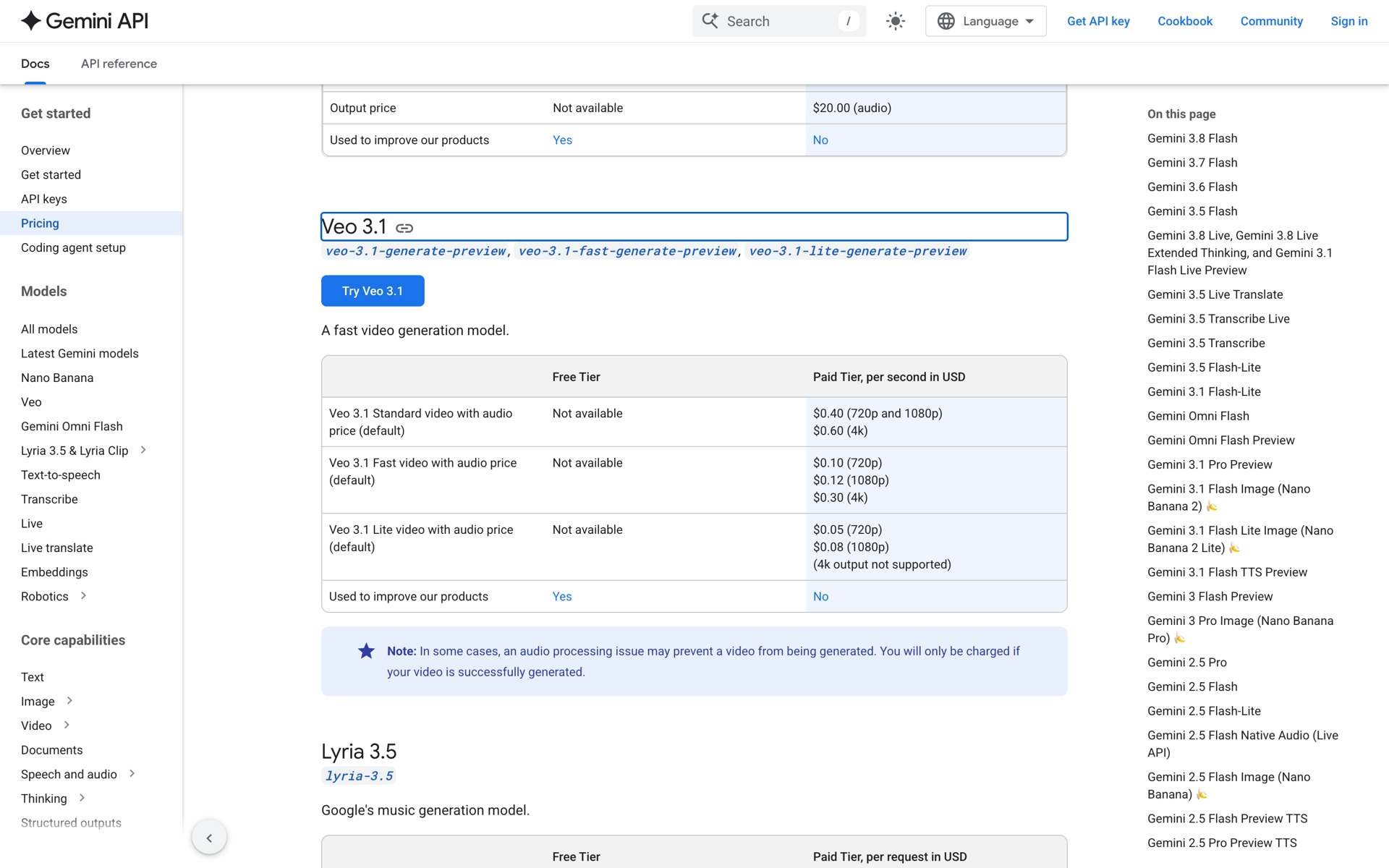
Gemini API pricing page, captured 2026-09-19, showing per-second USD rates for all three Veo 3.1 variants.
Google Veo 3.1
Three variants share one API surface: veo-3.1-generate-preview, veo-3.1-fast-generate-preview and veo-3.1-lite-generate-preview. Audio is included in the default price on all three. Google charges only if the video is successfully generated, and notes that an audio processing issue can occasionally block generation.
Best for: teams moving off sora-2 or sora-2-pro who want the price to go down rather than up, and who need synchronized audio to keep working.
Not for: anyone who needs to test before committing budget. There is no free tier on any Veo variant.
Runway API
Runway's developer tier is pay as you go: video from $0.05 per second, images from $0.01 each, audio from $0.0025 per second, billed on one invoice. It exposes several model families behind a Model Router, including Seedance 2.5, so one integration reaches more than one lab's models. You can start without a credit card.
Best for: teams that want to stop betting on a single provider after being burned by exactly that, and who value one invoice over the lowest unit price.
Not for: workloads where you need to pin one specific model's behaviour permanently, since routing across labs is the point of the product.

Runway pricing page, API tab, captured 2026-09-19.
Seeddance API
The Seeddance API creates a task with POST https://www.seeddance.io/v1/videos/generations, then polls GET /v1/tasks/{task_id}, with a bearer token from Settings and a separate GET /v1/credits for balance. Six public model IDs are documented, from seedance-1.0-pro-fast through seedance-2.5. The Seeddance API documentation covers the request shape and the polling loop.
Best for: reference-heavy generation. seedance-2.5 takes up to 30 images, 10 videos and 10 audio files as references, produces 4 to 30 second output, and lets prompts address assets directly as @image1, @video1 and @audio1.
Not for: a straight resolution match with sora-2-pro. See the boundary below before you pick it.
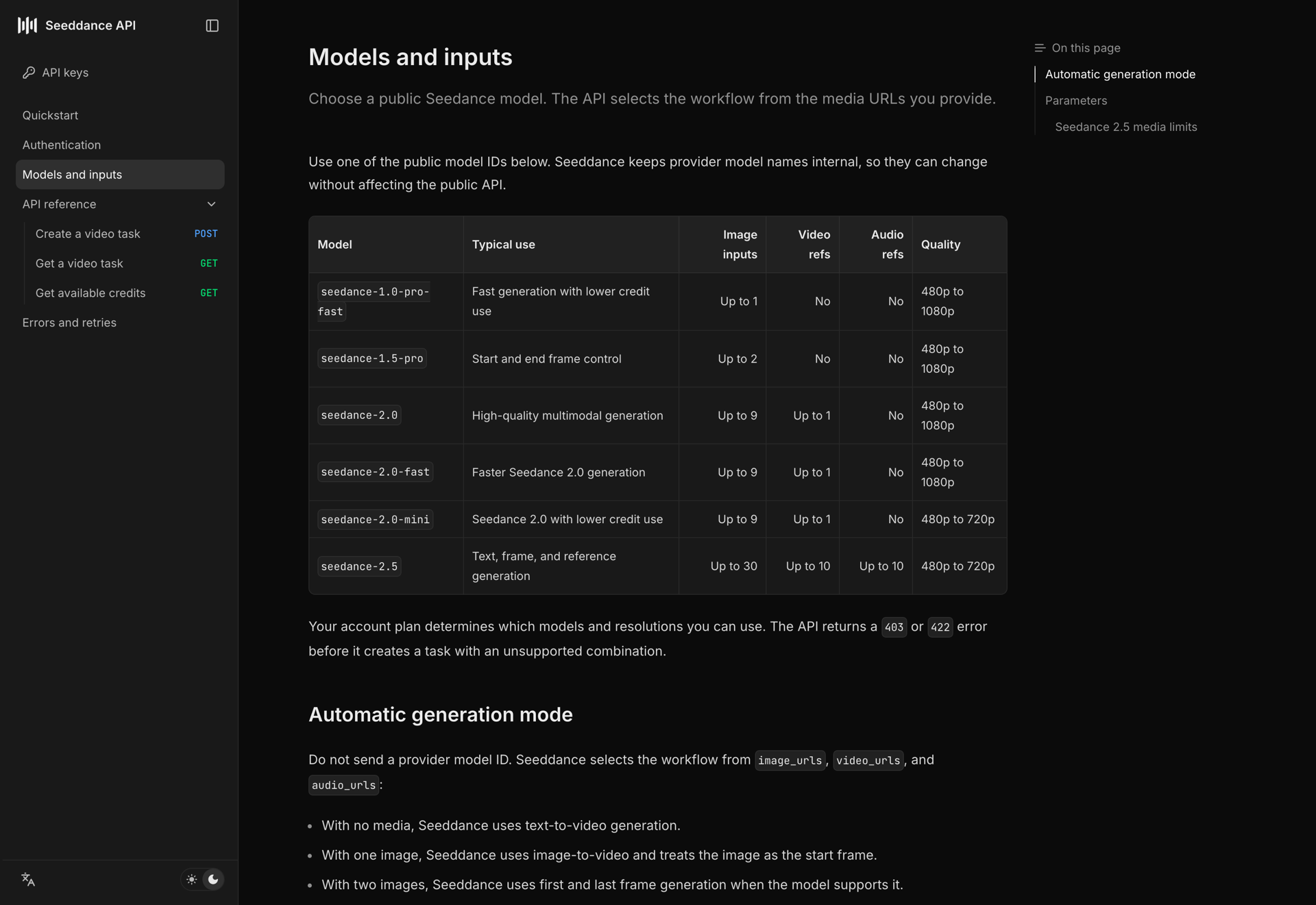
Seeddance API models documentation, captured 2026-09-19.
When to choose Seedance 2.5, and when not to
The useful version of this section is the part most vendor pages leave out.
Resolution is the catch. seedance-2.5 runs 480p to 720p. The Seedance 2.0 family runs 480p to 1080p. So if you were calling sora-2-pro at 1080p, the newer model is a downgrade on resolution and seedance-2.0 is the closer match. Picking 2.5 because the number is higher is the wrong move here.
Length and references are the win. Seedance 2.5 produces 4 to 30 second clips and accepts far more reference material than a text prompt plus one image. If your Sora usage was really "generate a shot that matches these existing assets," that is where it does better than a like-for-like swap.
The API is not OpenAI-compatible. Custom request schema, custom task polling. Budget for a rewrite, not a config change. Model and resolution access is also gated by account plan, and the API returns a 403 or 422 before creating a task if you ask for a combination your plan does not allow, which is at least a fast failure rather than a surprise bill.
Audio is per model. generate_audio only works with models that support synchronized audio. Sora 2's native audio is the feature most likely to have no direct equivalent, so confirm it for your chosen model before you assume parity.
If you want to evaluate output quality before touching the API, the Seedance 2.5 model page covers capabilities, and you can create a video from a prompt in the browser first. Credit costs per plan are on the SeedVideo AI pricing page, which quotes roughly $0.44 per video on Pro against $1.08 on Lite.
What to do before September 24
- Grep your codebase for
sora-2,sora-2-proand the Videos API endpoint. Include scheduled jobs and agent tool definitions, which are the ones people forget. - Export Sora content at
sora.chatgpt.com/sunsetnow rather than at the deadline. Deletion is permanent once any final export window closes. - Pick a target on price and audio, not on brand. At 720p the cheap tiers are close; at 1080p the gap is $0.70 against $0.40.
- Rewrite the call and the polling loop. None of the alternatives accept OpenAI's request shape.
- Handle failure generically. OpenAI has not published the exact response Sora calls will return after shutdown, so do not code against one specific status.
For a wider comparison than the four options here, the best Sora alternatives roundup covers the consumer-facing tools too, the AI video tool price comparison tracks rates across vendors, and the Seedance 2.5 benchmark data shows where it actually places on third-party leaderboards rather than on its own marketing.
FAQ
When exactly does the Sora API shut down?
September 24, 2026. OpenAI notified developers on March 24, 2026, and lists the Videos API, sora-2, sora-2-pro, sora-2-2025-10-06, sora-2-2025-12-08 and sora-2-pro-2025-10-06 with a shutdown date of 2026-09-24. The Sora web and app experiences were already discontinued on April 26, 2026.
Is OpenAI releasing a replacement for the Sora API?
No. On OpenAI's deprecations page, the recommended replacement column is empty for all six Sora entries, shown as three dashes. Other deprecations on the same page name a successor model, which makes the blank column a deliberate signal rather than an oversight. There is no announced OpenAI video generation endpoint to migrate to.
What is the cheapest replacement for the Sora API?
On published per-second rates, Google's Veo 3.1 Lite is $0.05 at 720p and $0.08 at 1080p, with audio included. Veo 3.1 Fast is $0.10 at 720p, matching what sora-2 charges at 720p today. Runway's API starts at $0.05 per second of video. Veo has no free tier, so evaluation costs money from the first call.
Will my Sora videos be deleted?
Yes, eventually. OpenAI says that after Sora is discontinued, and after the period of any final export window passes, it will permanently delete data associated with your use of Sora. You can export at sora.chatgpt.com/sunset by clicking Export, and you will get an email when the export is ready. OpenAI has said it will notify users by email if a final export window is offered.
Can I just change the base URL to another provider?
No. None of the available video generation APIs accept OpenAI's Videos API request shape. Veo uses Google's SDK through the Gemini API or Vertex AI, Runway uses its own platform API, and Seeddance uses a custom create-then-poll flow at /v1/videos/generations. Plan for rewriting the request construction and the polling logic rather than swapping a base URL.
Should I migrate to Seedance 2.5 or Seedance 2.0?
It depends on resolution. Seedance 2.5 runs 480p to 720p, while the Seedance 2.0 family runs 480p to 1080p. If you were generating at 1080p on sora-2-pro, seedance-2.0 is the closer match and 2.5 would be a downgrade. Choose 2.5 when you need long output of up to 30 seconds or heavy reference input of up to 30 images, 10 videos and 10 audio files.
What happens to my unused ChatGPT or Sora credits?
Per OpenAI's help center, any purchased ChatGPT or Sora credits can still be used for Codex. For refunds, OpenAI points to its standard ChatGPT subscription refund process rather than offering a Sora-specific one.
Start the migration this week
Five days is enough time to swap one endpoint, and not enough to discover on September 25 that a nightly job was calling sora-2. Search your repository first, export your content second, and pick a target third. If reference-driven generation is what you were using Sora for, the Seedance 2.5 model page is the place to check capabilities, and new accounts get free credits so you can compare output before writing any integration code.