MiniMax H3 (Hailuo 3.0) vs Seedance 2.5: Which Should You Use?
Last verified: September 2, 2026. Choose MiniMax H3 if you need open weights, local control, 2K delivery, or dense multimodal reference input in clips up to 15 seconds. Choose Seedance 2.5 if you need up to 30 seconds in one pass, larger reference packs, extension, or timestamp-level editing. Both generate synchronized audio. Without a same-condition test, this comparison does not rank image quality.
TL;DR
- MiniMax H3 is best for teams that want downloadable weights, self-hosting, 2K output, or a transparent pay-as-you-go API price.
- Seedance 2.5 is best for longer single-pass stories, larger reference packs, repeat extensions, and hosted editing workflows.
- H3 is not the better choice when one 20 to 30-second generation is central to the brief.
- Seedance 2.5 is not the better choice when local deployment or weight-level customization is mandatory.
Quick Answer
MiniMax H3 publishes 33B model weights and supports 4 to 15-second output, native stereo audio, and a 2K workflow. Seedance 2.5 stays hosted but reaches 30 seconds in one generation, accepts larger reference sets, and adds extension and editing controls. Base the choice on the production requirement you cannot change. Vendor showcase clips are insufficient for a quality ranking.
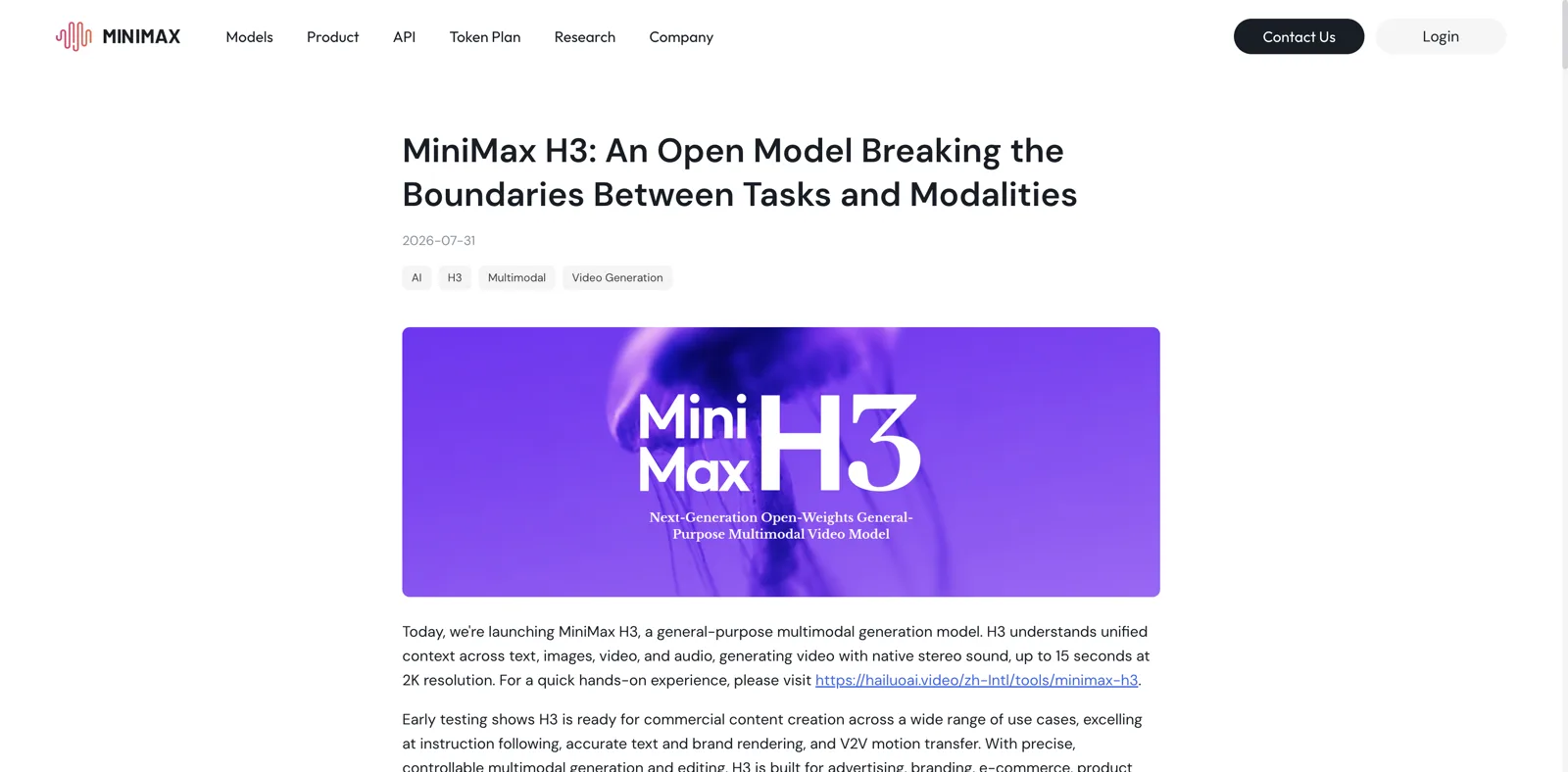
Official MiniMax H3 launch page, published July 31, 2026.
MiniMax H3 vs Seedance 2.5 comparison
| Decision factor | MiniMax H3 | Seedance 2.5 | Best for | Not for |
|---|---|---|---|---|
| Maximum native clip length | 4 to 15 seconds | Up to 30 seconds, with extension support | H3 for short controlled shots; Seedance for longer scene arcs | H3 when the brief requires one 20 to 30-second pass |
| Resolution on the compared access path | 768-pixel short side by default; 2K through H3-Regenerate-2K | SeedVideo AI public API documents 480p and 720p; the current web composer shown here is set to 720p | H3 for a documented 2K API path | Treating resolution labels as proof of better images |
| Audio | Native 32 kHz stereo | Joint audio-video generation with synchronized audio | Both for dialogue, ambience, and sound-led prompts | Assuming either model removes the need for an audio review |
| Reference inputs | Up to 9 images, 3 videos, and 3 audio clips; 12 files total | Up to 30 images, 10 videos, and 10 audio files | H3 for compact multimodal packs; Seedance for large reference libraries | Uploading every asset without assigning a clear role |
| Open weights | H3-Base weights released under the MiniMax H3 Community License | Hosted access; no official open-weight release is listed | H3 for local deployment and fine-tuning | Seedance when weights must stay inside your infrastructure |
| Hosted-only modules | Context-IR and the 2K regeneration workflow are separate hosted/API stages | The product and editing workflow are hosted | Seedance for one managed workflow | Calling H3's entire official stack fully self-hosted |
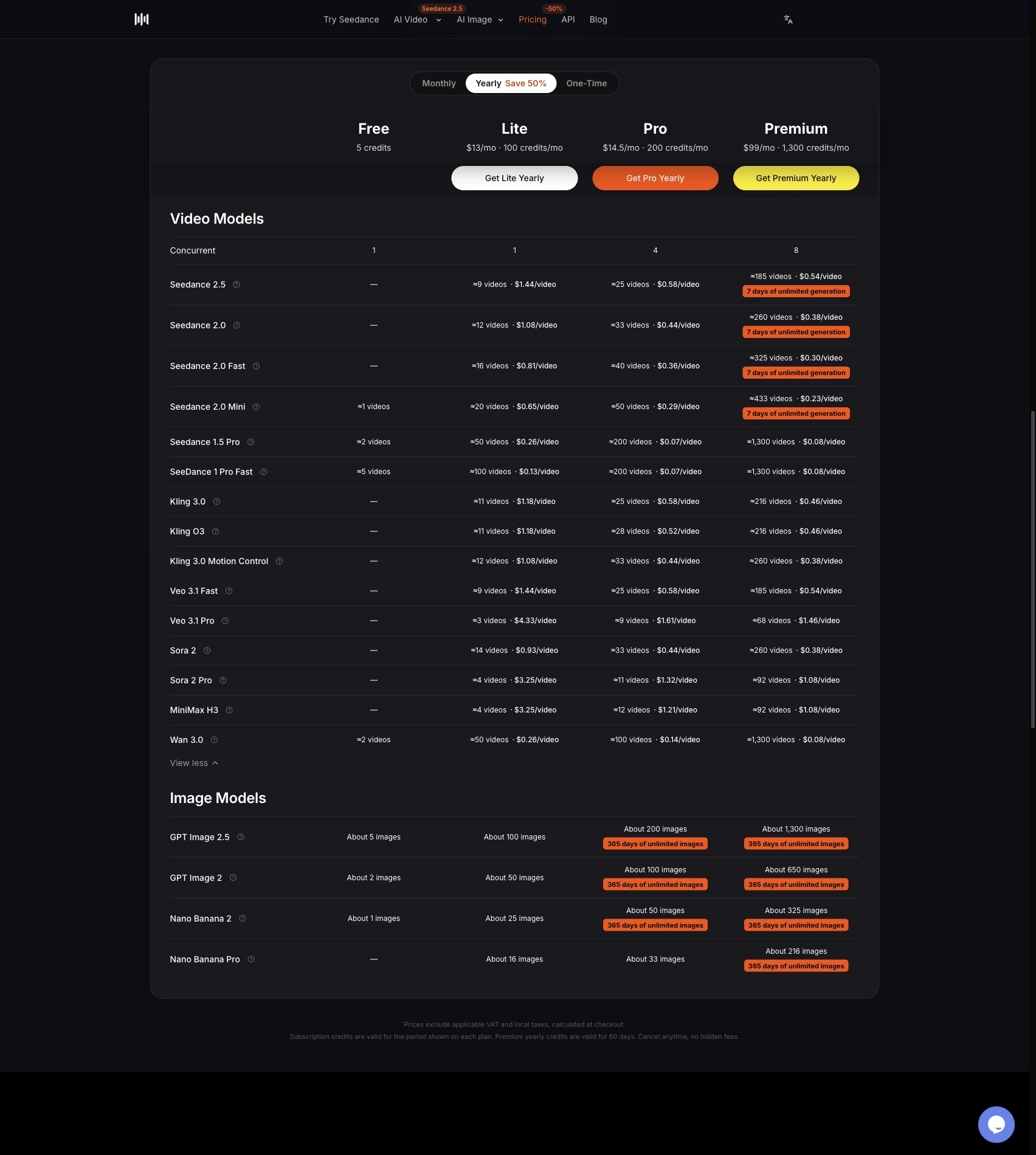
| Current pricing unit | 2K API: $0.13 per output second; 768P: $0.08 per output second | SeedVideo AI 720p base rate: 5 credits per output second before plan discounts | H3 for direct API-dollar forecasting; Seedance for plan-based credits | Comparing dollars with credits before applying the selected plan |
The specifications come from MiniMax's H3 launch, open-source system overview, and API pricing page, plus ByteDance's Seedance 2.5 launch and the SeedVideo AI public model documentation.
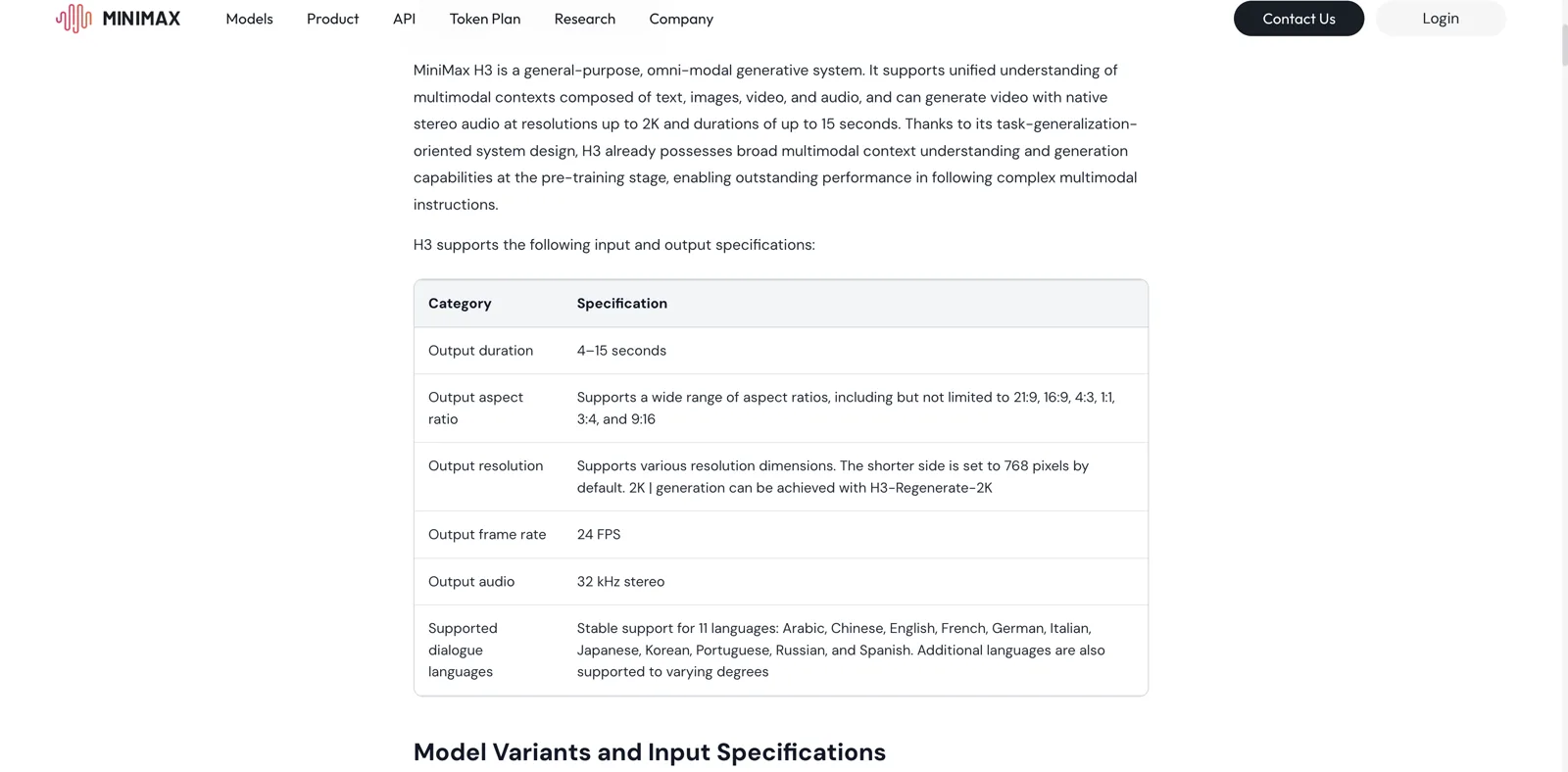
Official MiniMax H3 system specification table.
Price: compare completed shots, not billing labels
MiniMax publishes direct API prices for H3. A 15-second 2K output is $1.95 at the listed $0.13 per second. The same duration at 768P is $1.20 at $0.08 per second. Extra reference images, input video, Context-IR, and 768P-to-2K regeneration can add separate charges.
SeedVideo AI uses credits. At the documented 720p base rate of 5 credits per second, 15 seconds is 75 credits and 30 seconds is 150 credits before a plan discount. The final dollar cost changes with the plan, annual or monthly billing, and the number of attempts you keep. The AI video pricing comparison explains the credit-to-approved-shot calculation.
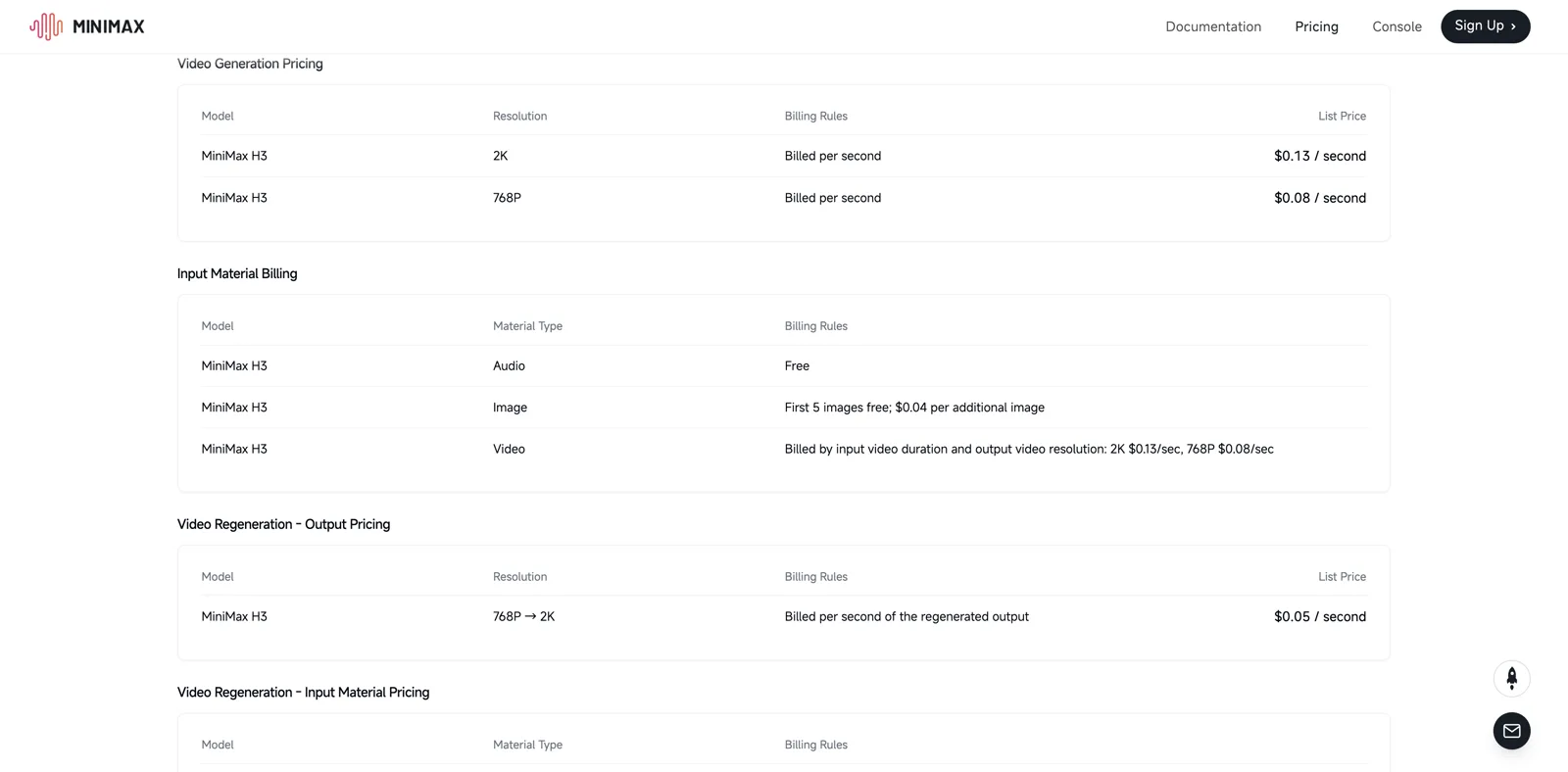
Official MiniMax H3 pay-as-you-go API pricing on September 2, 2026.
For a fair budget test, give both models the same shot brief and acceptance checklist. Track total spend, attempts, generation time, and approved shots. Include every retry in the calculation because a low first-render price says little about the cost of an approved result.
Three real task scenarios
1. You need local deployment or model customization
Choose MiniMax H3. The released H3-Base weights support local inference, private infrastructure, fine-tuning, and custom toolchains.
MiniMax says H3-Context-IR relies on hosted models and services and is not part of the open-source release. The official 2K path also uses H3-Regenerate-2K. A local H3-Base setup therefore does not automatically reproduce every result or convenience of the hosted workflow.
Best for: research teams, infrastructure owners, and studios with GPU capacity.
Not for: teams that want a managed browser workflow and do not want to maintain inference infrastructure.
2. You need a 20 to 30-second scene with many references
Choose Seedance 2.5. ByteDance documents up to 30 seconds in one generation, two extension rounds, and up to 30 images, 10 videos, and 10 audio clips as references. That makes it a better fit for a longer product story, music-led sequence, or multi-beat scene that should stay in one generation.
Large reference capacity is useful only when each file has a job. Label the hero product, character, location, motion sample, sound cue, and ending frame in the prompt. A smaller, well-assigned pack is often easier to control than an unstructured folder.
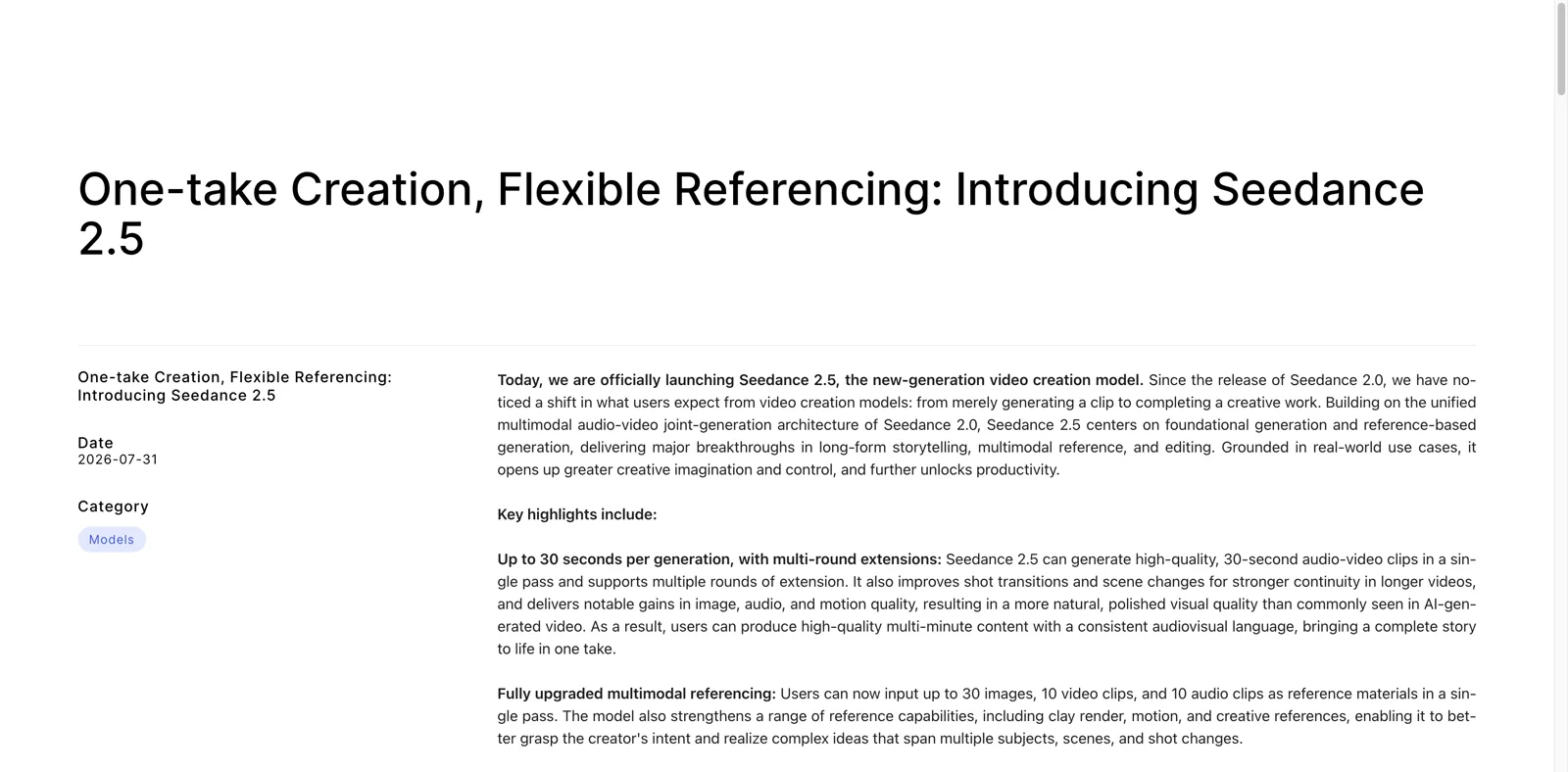
Official ByteDance Seedance 2.5 launch article, published July 31, 2026.
Best for: longer scene arcs, dense reference packs, and hosted extension or editing.
Not for: projects that require downloadable weights or offline inference.
3. You need predictable campaign throughput
Run a small approval test. Use three shot types: a talking medium shot, a product close-up with readable text, and a motion-heavy wide shot. Keep prompt, references, duration, aspect ratio, and sound request as close as the products allow. Score subject consistency, text accuracy, motion, audio, and repair time separately.
H3 gives a direct dollar-per-second starting point. Seedance gives a credit quote inside the hosted workflow and can cover a longer shot in one request. Compare the amount spent against approved seconds delivered within the deadline.

Current SeedVideo AI composer with Seedance 2.5 selected. Account details are excluded.
Best for: agencies and in-house teams buying repeated deliverables.
Not for: making a quality claim from one vendor-selected showcase.
What this comparison cannot prove
This article uses public specifications, current pricing, official screenshots, and existing first-party product evidence. It does not include a new same-prompt, same-reference, same-duration generation test. It therefore does not rank cinematic quality, realism, prompt adherence, character consistency, or generation speed.
Those judgments require a controlled test with the source files and output settings published alongside the results. One prompt is not enough. Use several shot types and report failed attempts. For another constraint-based comparison, see Seedance 2.5 vs Wan 2.2.
Which model should you choose?
Choose MiniMax H3 when open weights, local deployment, 2K API delivery, compact multimodal reference packs, or direct API-dollar pricing matters most. Choose Seedance 2.5 when one-pass duration, large reference packs, extension, and hosted editing matter more.
If neither constraint decides it, run the three-shot approval test and compare cost per approved second. You can start with the Seedance 2.5 workspace or review the MiniMax H3 access options before assigning the same brief.
FAQ
Is Hailuo 3.0 the same as MiniMax H3?
This article uses "Hailuo 3.0" for the current Hailuo product generation built around MiniMax H3. MiniMax's research, API, and open-source pages name the model MiniMax H3.
Which model makes longer videos?
Seedance 2.5. ByteDance documents up to 30 seconds in one generation. MiniMax documents 4 to 15 seconds for H3.
Which model is open source?
MiniMax H3 releases H3-Base weights under the MiniMax H3 Community License. Context-IR is not included in that release, and the official 2K regeneration path is a separate hosted/API stage. Seedance 2.5 has hosted product and API access rather than an official open-weight release.
Is MiniMax H3 cheaper than Seedance 2.5?
The billing units differ. H3 lists $0.13 per second at 2K and $0.08 per second at 768P. SeedVideo AI uses credits and plan discounts. Compare the total cost of approved shots on the plan and settings you will actually use.
Which model has better video quality?
There is no defensible winner here because this article does not run a controlled same-condition test. Compare several shot types with shared references, fixed acceptance rules, and all retries counted.
Can I use the outputs commercially?
Check the current license or plan terms for the access path you use. H3 weights use the MiniMax H3 Community License. Hosted Seedance access follows the platform's plan and service terms. You still need rights to the people, brands, music, voices, images, and other input assets.