Sand.ai released MAGI-2 on November 24, 2026 with three claims that are easy to state and easy to check: it makes 30 seconds of 1080p video with sound in one generation, it cuts where the script says, and it speaks the lines you write. A day later we gave it a four-shot script with two characters and two lines of dialogue, and went through the result one feature at a time.
Is MAGI-2 worth using for scripted 30-second scenes? Yes, with one habit: check the wardrobe. In our run every cut landed within 0.44 seconds of its scripted time, both lines were spoken word for word in the right shots, the two characters held their faces across cuts, and each of the four camera setups came out as written. One instruction, a hood worn down, was ignored for the whole clip. The file was 1080p at 25 fps for $2.40, and it took 85 minutes to arrive.
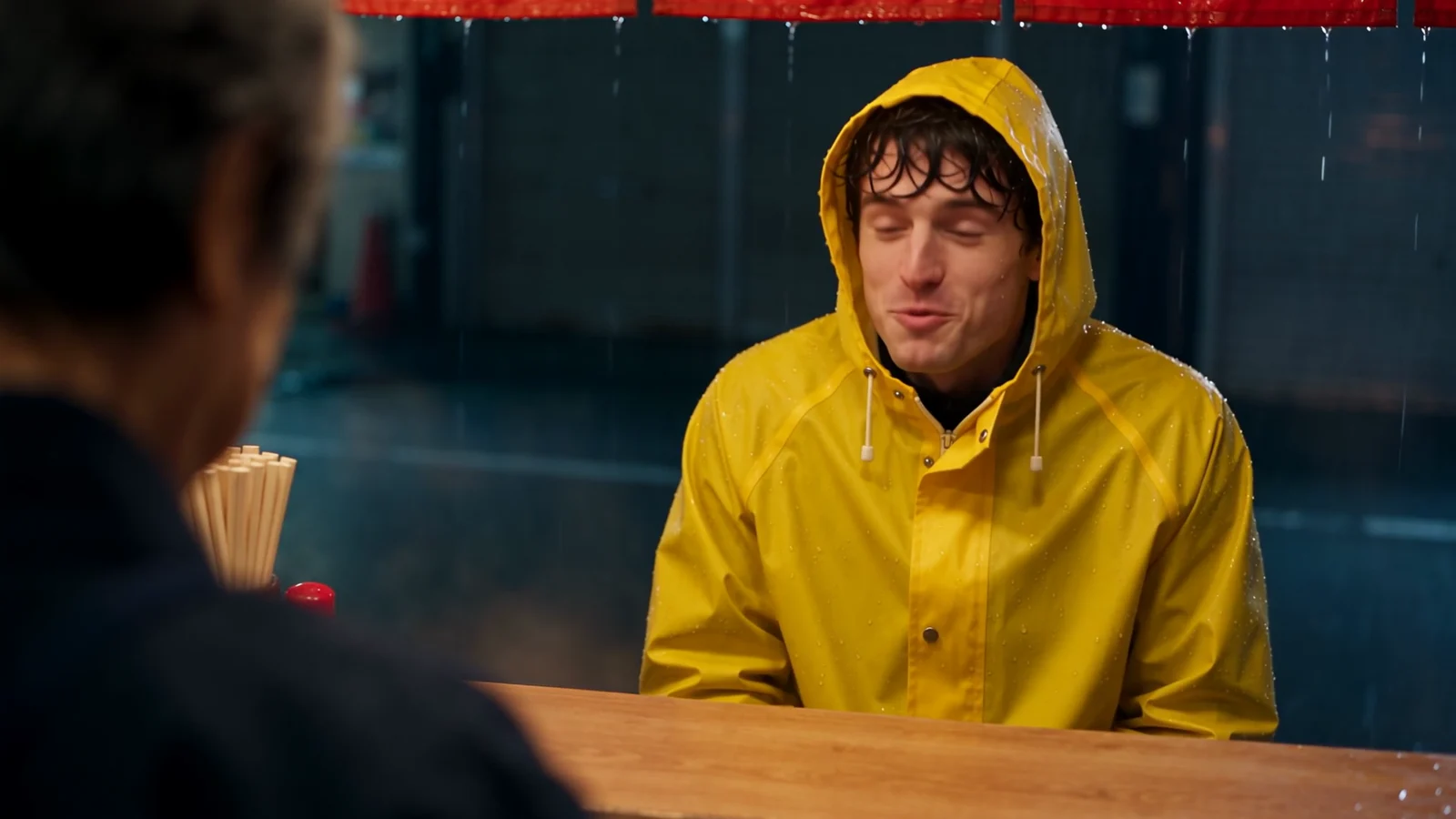
Shot 3 of our MAGI-2 test clip, November 25, 2026. The script asked for the hood to be down.
How this MAGI-2 test was run
One text-to-video request, 16:9, 30 seconds, sound on, sent once on November 25, 2026 with no prompt rewriting and no retries. Sand.ai's own API platform was not accepting top-ups yet, so the request went through a third-party API that resells MAGI-2 at Sand.ai's list price of $0.08 per second.
30-second scene in four shots with hard cuts. A rainy night at a small ramen stall under a red awning on a quiet side street: warm lantern light, rising steam, wet asphalt reflecting neon signs. Characters: Mei, a cook in her fifties with short grey hair, a navy apron and rolled-up sleeves. Tom, a bike courier in his twenties wearing a yellow raincoat with the hood down, wet dark hair. Shot 1 (0-7s): wide shot from across the street, the camera slowly pushes in toward the stall. Tom parks his bicycle and ducks under the awning. Shot 2 (7-15s): medium close-up of Mei behind the counter, ladling broth into a bowl. She looks up and says: "Last bowl of the night. You made it just in time." Shot 3 (15-23s): over-the-shoulder shot from behind Mei, looking at Tom on his stool. He wipes the rain off his face, smiles and says: "Smells like it was worth the ride." Shot 4 (23-30s): cut on the action as Mei sets the bowl down on the counter. Low-angle close-up of the bowl; Tom lifts noodles with chopsticks, steam drifts past his face, and the camera tilts up to his eyes closing. Sound: steady rain on the awning, broth simmering, the bowl touching the counter, distant traffic. No music. Realistic, cinematic, shallow depth of field.

The full MAGI-2 result, generated at 1080p and shown here at 720p without sound.
Cut times were read from the file with ffmpeg's scene detection, the dialogue was transcribed with Whisper with a timestamp per word, and framing and wardrobe were checked on frames from each shot. This is one generation, so each result below is "what happened once", not a success rate.
| MAGI-2 feature | What the script asked | What came back |
|---|---|---|
| Timed cuts | Cuts at 7, 15 and 23 s | 6.88, 14.80 and 22.56 s |
| Dialogue | Two lines, one per character | Both word for word, each in its shot |
| Wardrobe | Six stated details | Four kept, two loosely, hood ignored |
| Character consistency | Same two people in every shot | Held across all four shots |
| Camera | Push-in, over-the-shoulder, low angle, tilt up | All four as written |
| Output | 30 s at 1080p | 1920×1080, 25 fps, 30.16 s |
| Wait | Not stated | 85 minutes |
| Cost | $0.08 per second | $2.40 |
MAGI-2 timeline control: three cuts, all within half a second
Sand.ai's launch post says the model follows when each shot starts and how long it lasts. Our script put cuts at 7, 15 and 23 seconds. MAGI-2 cut at 6.88, 14.80 and 22.56 seconds: every cut early, by 0.12, 0.20 and 0.44 seconds, with the gap growing as the clip went on.
For a scene that plays on its own, that is close enough that nobody would notice. For a cut that has to hit a beat of music or a word of voice-over, half a second is visible, and you would trim in an editor. Kling 4.0, given the same script, landed within 0.08 seconds; the three-way numbers are in the MAGI-2 vs Seedance 2.5 vs Kling 4.0 test.
The fourth shot was also scripted to start on an action, the bowl being set down. MAGI-2 did that: the last shot opens with the bowl in Mei's hand, already moving toward the counter.
MAGI-2 dialogue: both lines word for word
Mei's line, "Last bowl of the night. You made it just in time," starts at 11.5 seconds and ends at about 14.3, inside shot 2. Tom's line, "Smells like it was worth the ride," runs from 20.1 to about 21.2, inside shot 3. The transcript matches the script exactly, with no added or dropped words, and in the frames across each line the speaker's mouth is moving.
MAGI-2's track was also the loudest of the three models we ran on this script, at a mean level of about -21 dB against -27 and -33 dB. What this test did not judge is how natural the voices sound. The earliest detailed hands-on we have read, from the Chinese creator Khazix (数字生命卡兹克), calls the voices clearly synthetic, about a generation behind the best current model; treat voice quality as the open question and listen to a short test before you commit to a dialogue-heavy piece.
Prompt adherence: five wardrobe details kept, one ignored
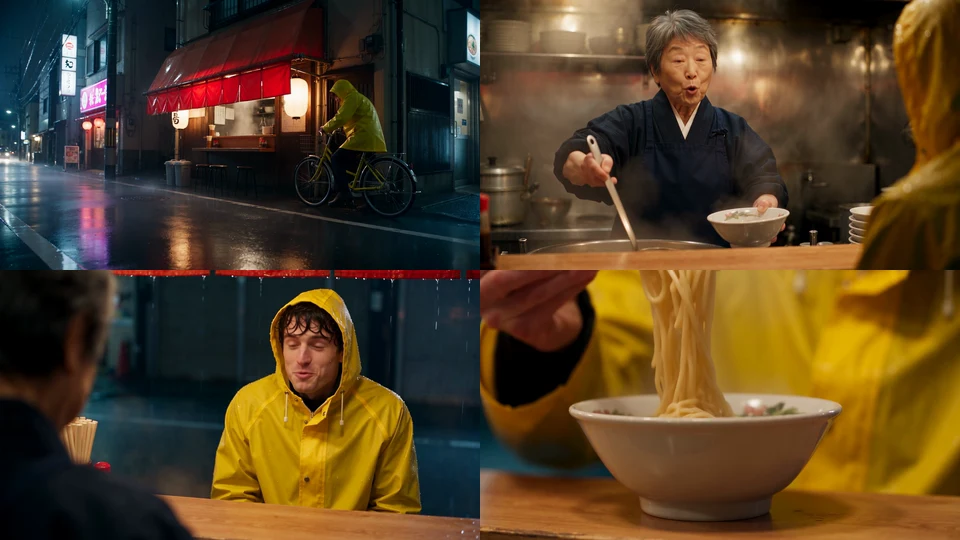
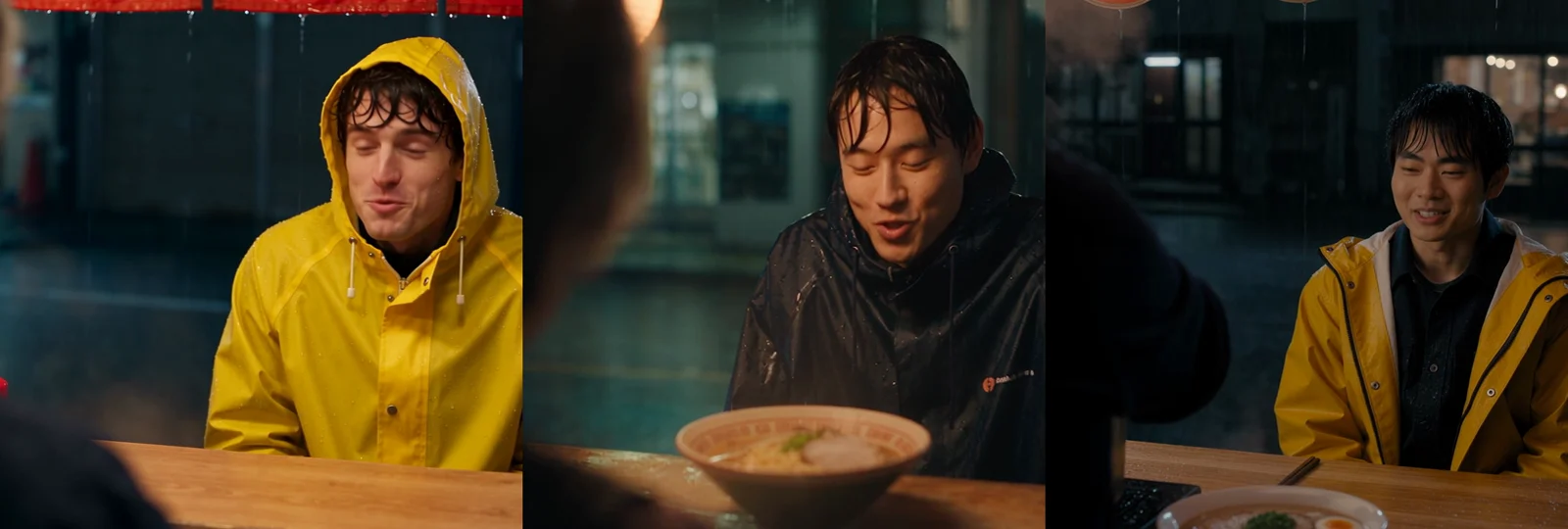
One frame from each of the four shots.
The script fixes six things about how the two characters look. MAGI-2 kept four cleanly, two loosely, and ignored one:
| Detail in the script | In the clip |
|---|---|
| Mei: short grey hair | Yes |
| Mei: navy apron | Navy, but it reads as a tied work jacket more than an apron |
| Mei: rolled-up sleeves | One forearm bare, the other sleeve long |
| Tom: yellow raincoat | Yes |
| Tom: wet dark hair | Yes |
| Tom: hood down | No, up from the first frame to the last |
The setting was read literally: a shopfront stall under a red awning on a narrow street, lantern light, steam, and neon reflected in the wet road. Tom rides in on a bicycle, parks it and walks under the awning before the first cut, wipes the rain off his face in shot 3, and lifts noodles with chopsticks in shot 4.
One physical slip is visible in shot 2: the ladle is nearly as wide as the bowl it fills. The ignored hood is the more useful finding. A negative-style detail attached to a garment ("with the hood down") lost to the model's idea of a person in a raincoat in the rain. If a detail like that matters, state it as its own sentence, or fix it with a reference image, which MAGI-2 accepts.
Character consistency across four shots
A multi-shot generation only works if the people stay the same after each cut. Here they did. Tom's raincoat is the same yellow in shots 1, 3 and 4, with the same white drawcords in shots 3 and 4, and his face and wet curly hair match between the over-the-shoulder shot and the final close-up. Mei's face, hair and jacket match between her own close-up and the back-of-head view in shot 3. The counter, the bowl and the yellow of the raincoat carry across every cut.
That was done from text alone, without the reference images MAGI-2 is designed to take.
Camera control: every setup as written, including the low angle
The script names four camera setups, and all four are in the clip:
- Wide shot with a slow push-in. The first shot starts across the street and is visibly tighter on the stall by the time of the cut.
- Medium close-up. Mei behind the counter, with Tom's shoulder at the edge of frame.
- Over-the-shoulder. Shot 3 looks past the back of Mei's head at Tom.
- Low-angle close-up, then a tilt up. The last shot sits at counter height on the bowl and tilts up through the steam to Tom's eyes closing.
The low angle is worth a note. Seedance 2.5 and Kling 4.0, given the same words, both framed the bowl from above. MAGI-2 was the only one of the three to put the camera where the script said.
Output quality, wait time and cost
The file is 1920×1080 at 25 frames per second, 30.16 seconds long, H.264 at about 7 Mbps with a stereo 44.1 kHz track. MAGI-2 has no other resolution, so there was nothing to choose.
It cost $2.40. That is the lowest price for 30 seconds of 1080p among the models that can do it in one generation; Wan 3.0 lists $6.00 and Kling 4.0 $7.05 for the same length. The catch is that there is no draft tier. Five attempts at a 30-second prompt cost $12 on MAGI-2, where a model with a 480p setting lets you iterate for a fraction of that and pay full price once. Until you know a prompt works, test MAGI-2 at 5 to 10 seconds ($0.40 to $0.80).
It took 85 minutes from submitting the request to having the file. Most of that was queueing at a reseller one day after release, so it says more about launch week than about the model. Plan around it anyway if you need MAGI-2 clips in the next few days.
What this test did not cover, shown in Sand.ai's own clips
Text-to-video leaves out three of MAGI-2's headline features. The clips below are Sand.ai's, from its launch post, and we have not reproduced them.
Reference inputs. A request can carry up to 10 images, 5 videos and 5 audio clips. In Sand.ai's example, a reference board fixes one character and three gardens, and the clip moves her through all three.


Style changes inside one take. Sand.ai conditioned this 30-second shot on five paintings and let the style change as the camera walks.
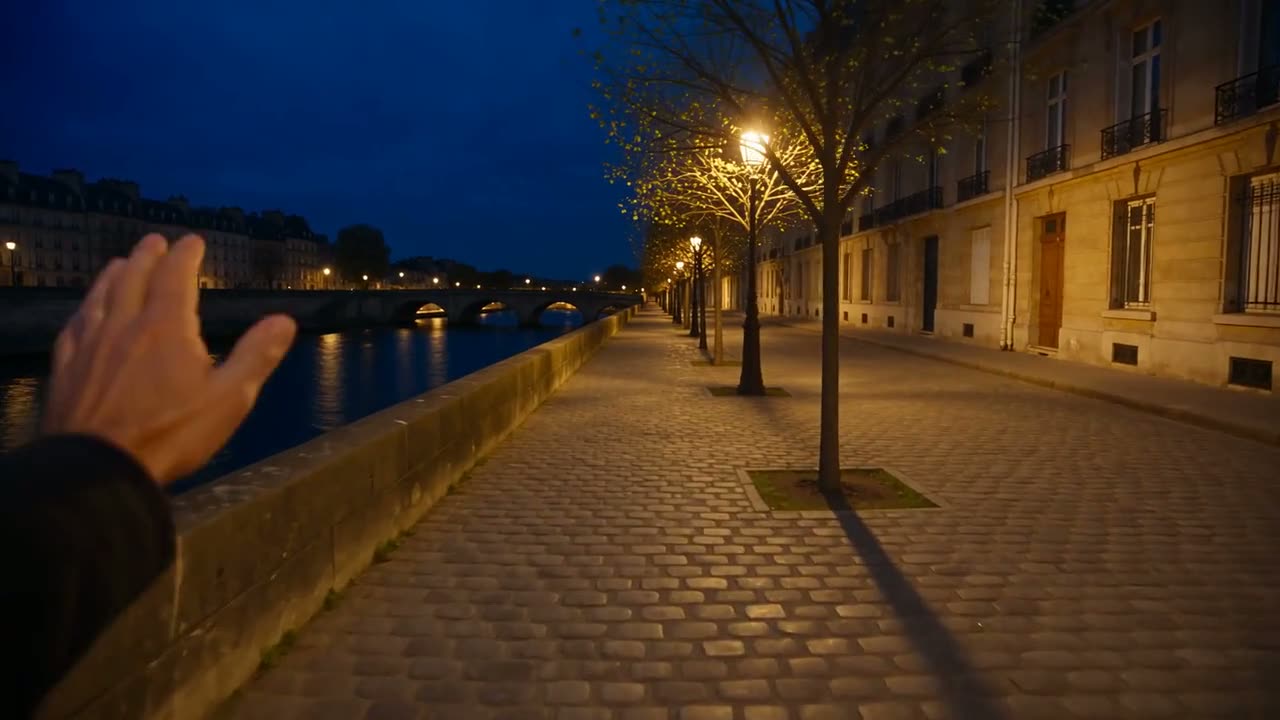
Editing an existing video. Listed by Sand.ai, not tested here.
The Magi2 AI video generator site, which is built around this one model, walks through each of these modes with sample prompts.
Sand.ai also names its own weak spots: extreme high-speed motion, 2D animation in medium and wide shots, and busy soundscapes. Our scene had none of the three, so it neither confirms nor contradicts them.
How MAGI-2 ranks and what other testers found
On the Artificial Analysis video leaderboards on November 25, 2026, MAGI-2 was first for image to video with audio (Elo 1165, with Seedance 2.5 at 1161) and first for image to video without audio (1151), second for text to video without audio (1144), and outside the top five for text to video with audio. Its best results are with an image as the starting point; our test used the mode where it ranks lowest.
Two early hands-on write-ups in Chinese are worth reading alongside this one. Khazix's test rates the camera work and instruction following highly and the multi-reference consistency as solid, and marks down the voices, the picture finish next to Seedance 2.5, and small physical details. APPSO's ten cases include a 30-second driving take and timed color flashes that landed on their marks, and report no failures. Our single run agrees with both on timing and camera work.
Who should use MAGI-2
- Use it for scripted multi-shot scenes at 1080p on a budget, single takes up to 30 seconds, and shots where camera height and movement are part of the brief.
- Check before you rely on it for exact wardrobe states, cuts that must hit a beat, and voices that carry the piece.
- Look elsewhere for cheap low-resolution drafts, 4K, and anything due in the next hour this week.
The MAGI-2 model page on SeedVideo AI lists its settings, and the MAGI-2 guide covers specs, API limits and how to write a timed prompt. For the other models that reach 30 seconds, see the 30-second and longer video roundup.
FAQ
Is MAGI-2 good?
In our test it followed a four-shot, 30-second script closely: cuts within 0.44 seconds, both lines of dialogue word for word, consistent characters and every camera setup as written, with one wardrobe detail ignored. Independent leaderboards place it first for image to video and lower for text to video with audio.
How accurate is MAGI-2's timeline control?
In one run with cuts scripted at 7, 15 and 23 seconds, MAGI-2 cut at 6.88, 14.80 and 22.56 seconds. Every cut was early, by 0.12 to 0.44 seconds.
Does MAGI-2 generate speech from the prompt?
Yes. Lines written in quotation marks with a named speaker were spoken word for word by the right character in the right shot, in the same generation as the picture.
How long does MAGI-2 take to generate 30 seconds?
Our 30-second request took 85 minutes on November 25, 2026, one day after release, most of it in a queue. Expect that to fall as capacity catches up.
How much does a MAGI-2 video cost?
$0.08 per second at 1080p, the only resolution: $0.40 for 5 seconds, $0.80 for 10 and $2.40 for 30. There is no cheaper draft tier.
What resolution and frame rate does MAGI-2 output?
1080p at 25 frames per second, with no lower tier. The file from our test was 1920×1080 with a stereo audio track.